Can You Assist Me?
June 8, 2011
8 comments
Categories: #WordlessWednesday, California Farmers, Farm & Ranch Life, Horses
#WordlessWednesday, Horses, Ranch
A lively #agchat discussion on the EPA last night prompted some further discussion on twitter during the after party. 140 characters was just not enough so I have thrown together some further thoughts here.
First, I have no doubt that the EPA (Environmental Protection Agency), CEPA (California Environmental Protection Agency), CAQCB (California Air Quality Control Board), CWRCB (California Water Quality Control Board) and the NCWQCB (North Coast Water Quality Control Board) were all implemented with the best of intentions. However, we all know where the road goes that is paved with good intentions. My comments are on all of these agencies as they overlap and often work together to address the same issues that I have been involved with. Also, these thoughts are from my personal experience in dealing with these agencies as they relate to my area: National Forest, private timber, irrigated and non-irrigated ag land, water quality and salmonid habitat. Read more…
UPDATE - May 24
The CDFA has posted current cases by county and status of those horses on their website http://www.cdfa.ca.gov/ahfss/animal_health/equine_herpes_virus.html.
UPDATE - May 21
As of Saturday, May 21, 10 horses in California have been confirmed, two in Colorado, one each in Washington and Alberta. In Colorado there are also six horses that have shown the symptoms of the virus.
EHV-1 is most commonly spread by direct horse-to-horse contact, but can also be carried on contaminated tack and clothing.
It is believed that horses that are current on their vaccination are likely protected as flu-rhino includes EHV.
I am providing this letter of guidance, from Colorado State, for horse owners whose horses may have been exposed to horses with EHV-1. Read more…
During my check on the alfalfa today, to my dismay, I spotted several plants that show signs of the dreaded alfalfa weevil. The first picture is of healthy alfalfa.
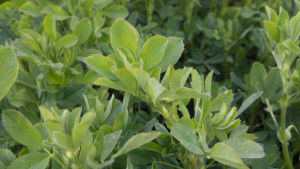
Alfalfa Without Weevil Damage
This second picture, shows what an alfalfa plant looks like that is being consumed by the alfalfa weevil.
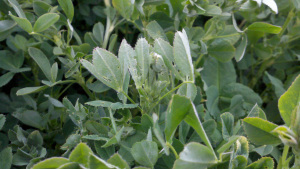
Alfalfa Plant Being Eaten By Weevils
Right now, there is approximately 2 ton of alfalfa per acre. With the current weather conditions, days not reaching 70 degrees and nights in the 20′s and 30′s, growing has stopped and the forecast for the next 8-10 days shows the same. These temperatures do not equate to growing days, so the alfalfa is essentially stalled.
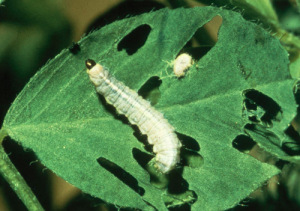
Alfalfa Weevil Larvae
Additionally, this weather will not allow for me to cut the hay as it is not warm enough to cure. If we were to have 8-10 days of day time temperatures over 74 and no rain, I could cut now and be fine. However, this is not case and the weevils will continue to eat the plants, causing them to stop growing and reduce the tonnage per acre by as much as a half ton over the next two weeks, which is the soonest I might be able to cut.
On 130 acres, that half ton per acre equals 65 ton, which at current prices would mean a loss of over $12,000, not to mention a reduction in quality that would likely result in a loss of more than $15,000. With that potential loss, I will be spraying tomorrow or Wednesday, providing the wind is not blowing, to save what I have and hopefully allow for an additional increase of a quarter to a half ton more growth. This will be the first time in three years that I have had to spray for weevils. Got caught in a cycle.
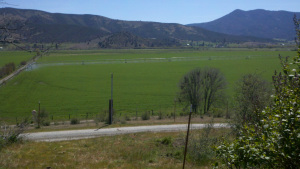
Day 1 of Irrigation for 2011
Due to nice spring rains, we were able to hold off turning on the water until May 3 this year. Long range forecasts had shown another front coming in, but was adjusted on Monday to show upper 60′s and low 70′s without chance for rain.
While the alfalfa could have made it another five to six days without irrigation, I made the decision to stay ahead of the draw down and lay down an inch of water now to make sure that I was ahead of the water level for second cutting, so the plants do not get stressed. The master plan calls for starting 1st cutting in 12 days. We’ll see if the weather cooperates.
It was a pleasant morning flushing the mainline and discovering that for the first time in years, no risers were cracked or broken due to winter wear, livestock and wildlife. Not so pleasant is knowing that the power bills are going to start coming again…


