It’s More Than Corn: Grass v Grain, Some Simple Facts
I have now written seven posts pertaining to feeds and the feeding of cattle, with the hope to explain with clarity two things: corn is not the only feed fed to cattle and grass finishing cattle is less efficient than grain finishing.
Do not take this the wrong way, please. I have nothing against grass finished cattle. In fact, I fully support the marketing of the product as a wonderful opportunity to offer consumers more choices. In fact, I raise some grass-fed to meet that specific market.
What I do take exception to is when some individuals make claims that are untrue and misleading.
Claim: Grass finished cattle take the same amount of time to reach their end point.
Grass is wonderful for growing cattle, but due to the low digestible energy (DE), when compared to grain, is not an efficient means to finish cattle. Grain finished cattle reach an endpoint around 13 – 15 months of age, while grass finished cattle reach an endpoint around 19 – 23 months. An animals breed, genetics and frame size also play a role in determining how quickly an animal will reach their endpoint. However, the biggest factor is the animals diet; high energy yields quicker gains and lower energy yields slower gains.
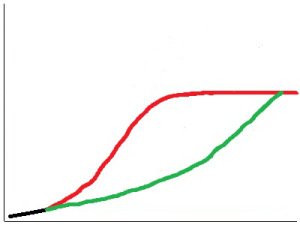
Grass vs Grain Sigmoid Growth Curve
The graph above shows the relationship of a grain fed animal (red) and a grass-fed animal (green). The Y-axis represents weight and the X-axis represents time. Cattle finished on grain reach their maximum size and finish sooner than grass-fed cattle.
What exactly is meant by “endpoint?”
It is also important to understand how animals deposit fat once they reach the top of the growth curve, signifying the end of skeletal and muscular growth and fat begins to deposit. Cattle begin to deposit fat beginning in the chest floor and ending at the top of the hip; from front to rear, bottom to top. Ranchers and cattlemen often refer to seeing a “doughnut” around the tail head, which is an indicator that an animal is fat and ready to process.
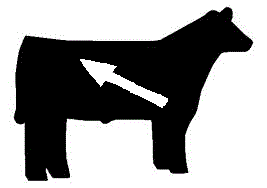
How Fat is Deposited
The endpoint for cattle is that point in their growth curves when they have enough fat to cover the carcass, to prevent drying, and enough intramuscular fat (marbling), to allow for a tender product. Remember, cattle only put on fat when their energy intake exceeds their bodies requirement for general maintenance and growth.
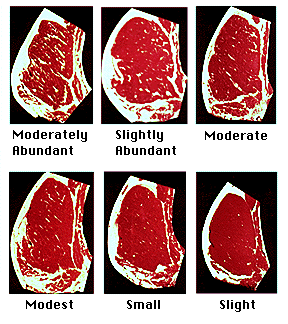
Stages of Marbling
The graphic above shows the amount of marbling, or intramuscular fat, within the rib eye. The top left is a steak that would grade a US Prime (very fat). Reading from left to right, top to bottom, the bottom right steak is one that would grade a US Standard (to lean). It is important to understand that an animal deposits subcutaneous fat (under the skin) prior to depositing intramuscular fat (marbling). The endpoint is reached when steer appears, from outside appearance, to have enough fat to at least be in the modest category for marbling. Marbling is important because that is the leading factor for tenderness and juicieness. Having said that, it is possible to have a prime grading steak that is tough and a select grading steak that is tender, due in part to genetics, but marbling is still used as the determining factor.
Claim: Grass fed cattle are better for the environment.
All cattle, raised under modern practices are good for the environment. All cattle are pasture grown. The finishing phase is where there is difference. Grain finished cattle, around 10 – 12 months, are moved to feedlots for 90 – 120 days (3 – 4 months) of higher energy intake, in the form of rations with a higher ration of grain to roughage. Grass finished cattle remain on pasture and/or are fed hay until they are finished, another 9 – 13 months.
This does not mean that one practice is better than the other, only different, in my opinion. Grain finishing is simply a more efficient means to getting cattle to their endpoint; fewer pounds are consumed in relation to pounds gained, thus, fewer days are required to finish.
Individual ranchers must assess what their own situation allows for on a regional basis. Grass finishing cattle will often reduce the number of cows an individual is able to carry on the land. Grain finishing allows an individual to move calves off the ranch to another location and favors being able to run more cows. Some regions, where winters are hard, will require significant stockpiling of hay to maintain animals through the winter, while warmer regions lend themselves to yielding grass year round, albeit lower in nutrient value during certain times of the year.
In conclusion, both grain and grass-fed cattle are viable options, depending on the circumstances. It is important to continue to be able to utilize both methods in order to offer consumers choices. Variety is a good thing. It is also important to be aware of the nutrient requirements of animals based on their phase of growth and use, to ensure that their dietary requirements are met.

